Overview
Mikasa Ackerman is the last living member of the Ackerman bloodline's main branch and the most formidable soldier in the Survey Corps. Born to an Ackerman mother and a father from the Azumabito clan of Hizuru, Mikasa possesses the latent combat abilities unique to the Ackerman family — superhuman strength, reflexes, and instinctive battle precognition that activate when a Ackerman awakens to their power through a "trigger" event. For Mikasa, this trigger was the overwhelming urge to protect Eren Yeager after he saved her from human traffickers who had murdered her parents. From that moment, her Ackerman abilities surfaced, transforming her from a traumatized child into a one-person army.
Mikasa joined the 104th Training Corps alongside Eren and Armin Arlet, graduating with the second-highest scores behind only the coldly efficient Annie Leonhart. Her ODM Gear mastery, hand-to-hand combat skills, and tactical awareness placed her in the top tier of her generation. She was recruited into the Survey Corps' Special Operations Squad under Captain Levi, where she served as one of the elite soldiers protecting Eren from internal and external threats. Throughout the series, Mikasa's unwavering loyalty to Eren defines her character arc — a bond that becomes both her greatest strength and her most profound weakness. The red scarf Eren gave her when they first met becomes the central symbol of their relationship, representing the warmth, security, and belonging she found after losing everything.
Appearance
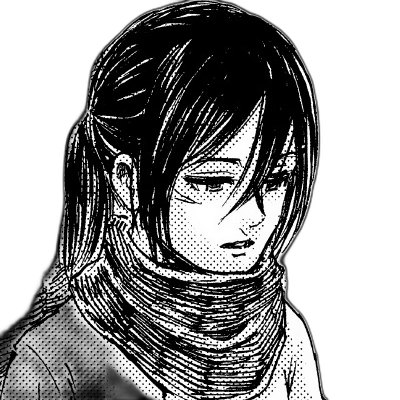
Mikasa is a tall, athletic young woman with a lean, muscular build honed by years of intense military training. She has pale skin, dark gray eyes, and shoulder-length black hair that she typically keeps pinned back in a bun or pulled behind her ears to maintain visibility during combat. Her most distinctive accessory is the red wool scarf gifted by Eren, which she wears constantly — even in battle, even in summer, and long after the scarf has frayed and faded. The scarf represents her emotional anchor to Eren and the only family she has left.
In her Survey Corps uniform, Mikasa wears the standard brown cropped jacket over a white shirt, light brown trousers, and high leather boots fitted with ODM Gear straps. She wears the Wings of Freedom cloak on expeditions beyond the Walls. After the time skip, Mikasa adopts a more mature look — her hair is grown longer, and she wears an olive-green military jacket with a white scarf that replaces the original red one, though she keeps the remains of Eren's scarf close. Her face shows the weathering of years of combat, with a permanent shift from her youthful softness to a hardened, world-weary expression. The Azumabito clan's formal clothing — a white haori with family crest patterns — is worn during diplomatic visits, subtly acknowledging her Hizuru heritage.
Personality
Mikasa's personality is defined by a quiet, stoic exterior that masks deep emotional turmoil. She speaks sparingly and rarely expresses her feelings through words, instead channeling everything into action. Her default expression is one of calm, almost cold detachment — a defensive mechanism developed after the trauma of watching her parents murdered in front of her. This emotional restraint makes her appear unapproachable to outsiders, but those who know her understand the fierce loyalty and protectiveness that drive her every action.
Her attachment to Eren is the central axis of her personality. Mikasa's world revolves around Eren's safety to an obsessive degree — she intervenes in his fights, shadows his movements, and reacts with disproportionate violence to anyone who threatens him. This dependency is rooted in her Ackerman instincts: the "trigger" mechanism creates a psychological drive to protect the person who awakened her powers. Mikasa's constant refrain of "Ereh" whenever danger appears becomes a defining verbal tic, simultaneously endearing and suffocating. Her inability to imagine a life beyond protecting Eren becomes her greatest challenge, especially when Eren himself recoils from her smothering care, telling her she is not his mother and that she should stop following him.
Despite these flaws, Mikasa possesses a strong moral compass. She cares deeply for her comrades in the Survey Corps — particularly Armin, Jean, and Sasha — and is devastated by their losses. She shows surprising gentleness toward children, such as her kindness to the orphans in the Uprising arc. After the time skip, Mikasa grapples with the growing realization that Eren has become something she cannot protect him from. Her journey in the final arc is one of painful self-discovery: learning to let go, to think for herself, and eventually making the impossible choice to kill the person she loves most.
Abilities & Power
As an Ackerman, Mikasa possesses inherited superhuman abilities that set her apart from ordinary soldiers. The Ackerman bloodline was engineered centuries ago by the Eldian Empire to serve as bodyguards for the royal family. When an Ackerman awakens — triggered by a strong will to protect someone — they gain access to the accumulated combat experience of all previous Ackermans through the Paths, manifesting as instinctive battle reflexes that operate faster than conscious thought. Mikasa's awakening happened at age nine when she killed two adult men who had murdered her parents, triggered by her desperate need to protect Eren.
Mikasa's ODM Gear proficiency is second only to Levi Ackerman within the Survey Corps. She can navigate urban and forest terrain with breathtaking speed, executing precise Titan kills that require minimal blade expenditure. Her signature maneuver involves using buildings or trees as launch points to accelerate into Titan napes at angles that most soldiers cannot compensate for. She is also an exceptional hand-to-hand combatant — during the 104th Training Corps' unarmed combat drills, she defeated every male cadet, including Reiner Braun, using counterthrows that exploited her opponents' momentum against them.
Mikasa is proficient with all Survey Corps standard weaponry, including blades, hooks, and Thunder Spears. Her physical strength is far beyond normal human levels — she can carry full-grown adults while using ODM Gear without losing mobility. Her endurance allows her to fight for extended periods even while wounded. During the battle to retake Wall Maria, Mikasa held her own against the Armored Titan and the Colossal Titan simultaneously, buying critical time for the operation. She also demonstrates exceptional tracking skills, capable of following Titan movement patterns and predicting their behavior based on subtle environmental clues. After the time skip, her skills have only sharpened, making her the de facto leader of the Survey Corps' remaining forces during the final war.
Story Arcs
Origins — Trost and the Female Titan
Mikasa's backstory is revealed early in the series. When she was nine years old, human traffickers murdered her parents in their mountain home, intending to sell Mikasa into slavery in the capital. Eren Yeager, acting on a vague premonition, arrived at the scene with Armin, killed two of the traffickers, and gave Mikasa his red scarf. This act triggered Mikasa's Ackerman awakening — she finished off the remaining traffickers with cold efficiency. She then moved in with the Yeager family, becoming Eren's adoptive sister and developing the profound bond that defines her life.
During the Battle of Trost, Mikasa witnesses what she believes is Eren's death when he is eaten by a Titan. The grief nearly breaks her, and she fights with suicidal abandon until she exhausts her ODM Gas. In that moment of despair, she resolves to kill as many Titans as possible before dying — but Eren's Titan form emerges and saves her. The reunion confirms her purpose: protect Eren, no matter the cost. This mindset carries through the 57th Expedition, where she serves alongside Captain Levi's squad and fights the Female Titan. When Annie Leonhart is revealed as the Female Titan, Mikasa engages her in a brutal combat sequence, demonstrating that she can go toe-to-toe with another elite fighter.
Uprising — Identity and the Reiss Family
During the Uprising arc, Mikasa's loyalty is tested as the Survey Corps moves against the corrupt government. She serves as Eren's bodyguard while the Corps investigates the Reiss family's true role in the Walls' history. When Kenny Ackerman and the Anti-Personnel Control Squad attack, Mikasa fights alongside Levi, demonstrating her worth as an Ackerman warrior. Her encounter with Kenny — who recognizes her as part of the Ackerman lineage — plants early seeds about her heritage. The arc also reveals Mikasa's Hizuru connection through the Azumabito clan, though this plotline does not fully develop until the post-time skip arc.
In this arc, Mikasa shows her softer side. She bonds with Historia, the orphaned children they protect, and the injured soldiers under her care. Her interactions with Jean Kirstein reveal a begrudging mutual respect — Jean openly admires her, and Mikasa tolerates his presence in a way she does not for other outsiders. The arc ends with the Survey Corps victorious but Eren increasingly disturbed by his memories of his father, Grisha Yeager. Mikasa senses Eren pulling away but misinterprets it as temporary trauma rather than the beginning of his descent.
Marley and the War for Paradis
The timeskip transforms Mikasa from a prodigy soldier into a hardened veteran. At nineteen, she is the most experienced active member of the Survey Corps, having survived countless expeditions and battles. When the Survey Corps launches an invasion of Marley, Mikasa plays a critical role in the operation, engaging Marley's Warrior units in close-quarters combat. She battles Porco Galliard's Jaw Titan and Pieck Finger's Cart Titan with characteristic ferocity, though she struggles against enemies who fight with human intelligence rather than mindless Titan instinct.
The Marley arc marks the beginning of Mikasa's emotional crisis. She witnesses Eren's transformation from a rage-driven crusader into a cold, calculating force of destruction. When Eren activates the Rumbling and declares his intention to flatten the world, Mikasa refuses to accept it, clinging to the belief that the Eren she knew is still in there somewhere. The Survey Corps splits between those who support Eren — the Yeagerists — and those who oppose him. Mikasa, despite her love for Eren, sides with Armin, Hange, and the rest of the Corps against Eren's genocide.
The Final Confrontation — Letting Go
The final arc pushes Mikasa to her breaking point. She pursues Eren across the transformed terrain of the Founding Titan's colossal body, fighting through Pure Titans, Yeagerists, and even former allies transformed into monsters. Her battle against Annie Leonhart — a rematch years in the making — showcases how far she has come, but her attention remains fixed on Eren. In the Paths, she shares a final moment with Eren where he shows her an alternate reality — a vision of what their lives could have been if she had confessed her feelings and they had run away together.
Mikasa makes the impossible choice. She kills Eren, decapitating him with a blade as she kisses him, mirroring the image Ymir Fritz saw that showed her true love could mean letting go. This act breaks the Founding Titan's curse, freeing Ymir from her two-thousand-year imprisonment in the Paths. Mikasa carries Eren's head and buries him under a tree on the hill where they often sat as children. In the epilogue, Mikasa is seen visiting Eren's grave years later, still wearing his scarf, finally at peace. Her final words — "See you later, Eren" — echo her first words in the series, bringing the story full circle.
Relationship Network
Eren Yeager. Eren is the center of Mikasa's world. He saved her from slavery, gave her the red scarf, and awakened her Ackerman abilities. Their relationship is both a source of strength and a fatal dependency. Mikasa's love for Eren is deep and genuine, but her inability to see him as anything other than the boy she needs to protect prevents her from recognizing his darkness until it is too late. Her final act of killing Eren is the ultimate expression of love — letting go of her obsession to save the world and free him from his own curse.
Armin Arlet. Armin is Mikasa's other childhood friend and the closest thing she has to a confidant. While she does not share her emotions openly with him, she trusts his judgment and values his strategic mind. After Eren's fall, Armin becomes the person Mikasa relies on most heavily. Their bond is built on shared history and a mutual commitment to the survey corps ideals that Eren abandoned.
Levi Ackerman. Levi and Mikasa share the Ackerman bloodline, though they are not directly related. Levi recognizes Mikasa's potential and treats her as a peer soldier — perhaps the only person in the series whose combat skills match her own. Their interactions are minimal but respectful, built on mutual recognition of their shared heritage and combat philosophy.
Jean Kirstein. Jean harbors unrequited romantic feelings for Mikasa throughout the series. Mikasa is aware of this but does not reciprocate, though she grows to respect Jean as a reliable comrade. Their relationship is marked by Jean's awkward attempts at closeness and Mikasa's polite but firm boundaries. In the final arc, Jean fights alongside her against Eren, proving that his loyalty to her is genuine and selfless.
The Azumabito Clan (Hizuru). Mikasa's father was from the Azumabito family, making her the last living heir to their clan. Kiyomi Azumabito approaches Mikasa after the timeskip, revealing her heritage and attempting to use her as a diplomatic bridge between Paradis and Hizuru. Mikasa engages with this connection reluctantly, recognizing its political value but feeling no emotional attachment to a family she never knew.
Cultural Impact & Popularity
Mikasa Ackerman is a globally recognized female character in anime history. She consistently ranks in the top five of Attack on Titan popularity polls, often competing closely with Levi for first place. Her design — particularly the red scarf, the Survey Corps uniform, and her cold, determined expression — has become iconic in anime merchandising, appearing on apparel, figures, posters, and collectibles across the globe. The red scarf alone is one of anime's most identifiable character accessories, instantly evoking the character and her story.
Mikasa represents a significant milestone in female action character representation. Before Attack on Titan, strong female anime characters were often either sexualized or relegated to support roles. Mikasa broke this mold — she is genuinely the strongest soldier in her generation, her femininity is not played for fanservice, and her emotional depth is treated with respect. Her character sparked discussions about the "strong female character" trope, particularly the balance between power and vulnerability. Critics have praised her combat animation sequences, especially the 57th Expedition ODM fight against the Female Titan, as among the medium's finest action choreography.
The scarf symbolism has permeated fan culture, becoming shorthand for love, protection, and tragic attachment. Mikasa's final scene — visiting Eren's grave in the epilogue — generated massive emotional response across fan communities, with many considering it among the most emotionally powerful conclusions in anime history. Cosplayers frequently portray Mikasa, and her image appears in countless fan art pieces. Her "See you later, Eren" line became one of Attack on Titan's most quoted and analyzed lines, with fans debating its significance for years before the final chapters revealed its meaning.
Frequently Asked Questions
Mikasa and Levi are both members of the Ackerman clan but are not directly related. They descend from different branches of the same bloodline. Levi is the son of Kuchel Ackerman, while Mikasa's mother was an Ackerman who married into the Azumabito family of Hizuru, giving Mikasa mixed heritage.
The red scarf was given to Mikasa by Eren Yeager when they first met after her parents were murdered. Eren wrapped the scarf around her and told her he would always protect her. The scarf became a symbol of their bond and Mikasa's emotional anchor, representing the warmth and belonging she found after losing her family.
Yes, Mikasa kills Eren in the final chapter. After Eren initiates the Rumbling and transforms into the Founding Titan, Mikasa is forced to confront her adoptive brother. She kills him with a kiss, fulfilling the tragic vision Ymir showed her. This act ends the Titan curse and demonstrates Mikasa's ultimate choice — letting go of her obsession to save humanity.
Mikasa's mother was an Ackerman, but her father was from the Azumabito clan of Hizuru, a nation across the ocean. This makes Mikasa the last surviving heir of both the Ackerman bloodline and the Azumabito family. Kiyomi Azumabito reveals this heritage, and it plays a role in establishing diplomatic relations between Paradis and Hizuru.
Mikasa's first words in the series are revealed in the final chapters to be a memory from an alternate timeline shown through the Paths. When Eren showed Mikasa a vision of a life where they ran away together, her 'see you later' was said to Eren after that vision. It becomes a tragic callback that bookends the entire story, connecting the first chapter to the last.